Building your own drone is the best way to actually understand how they work — and it's far more approachable than it looks. The assembly is a weekend; the skill is choosing parts that match. This guide is the roadmap: what the parts are, how they fit, the order to build in, and links to the deep-dive guides for each decision. It's the front door to the whole design, propulsion and avionics library.
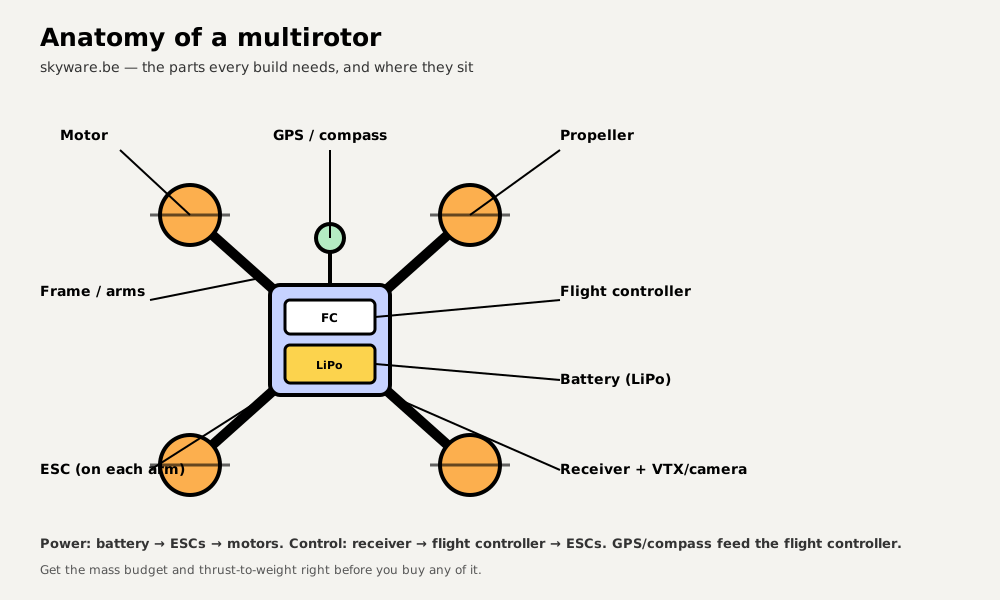
The seven core parts
| Part | What it does | Deep dive |
|---|---|---|
| Frame | The skeleton everything bolts to | Frame materials |
| Motors | Brushless motors spin the props | Motor sizing |
| ESCs | Turn battery DC into motor drive | ESC selection |
| Propellers | Convert motor spin into thrust | Propeller selection |
| Flight controller | The brain — keeps it stable, runs the software | FC selection |
| Battery (LiPo) | Stores the energy | Battery guide |
| Receiver + transmitter | The radio link you fly it with | Radio links |
Add a GPS/compass for position hold and a camera + video transmitter for FPV. That's it — everything else is payload.
The one decision that makes or breaks the build
Beginners buy a cool frame first. Engineers start with thrust-to-weight and the mass budget. Here's the chain that has to agree:
- Estimate your all-up weight (frame + parts + battery + payload) — the mass budget.
- Aim for total thrust ≈ 2× that weight so hover sits near half throttle.
- That thrust target picks your prop size, which picks your motor (and its KV), which sets the current, which sizes your ESC and battery.
Buy a matched set and it flies. Buy a screaming motor, a huge prop and a weak ESC and you'll cook something on the first throttle-up. Skip to the motor sizing guide for the numbers.
Don't design from a blank sheet. Pick a common size class (a 5-inch quad is the classic starter) and buy a known-good parts list, or a kit. Learn the whole chain — assembly, wiring, flight-controller setup, tuning, flying — on hardware that's proven to work, then design your own once the process is boring. The practical build guide follows exactly this philosophy for an AI-capable drone.
The build order
- Frame: assemble the frame and mount the motors to the arms.
- Power: solder ESCs to the power distribution (or an all-in-one board), then motors to ESCs. Get the battery-lead polarity right — reversing it kills electronics instantly.
- Flight controller: mount it (orientation arrow forward, vibration in mind — see the sensor suite), wire ESC signals, receiver and GPS.
- Props off, first power-up: connect to configurator software (Betaflight/PX4/ArduPilot), set it up, check motor directions and that the sticks do the right thing — all with props removed.
- Props on, first flight: in open space, hover low, feel it out.
- Tune: a fresh build flies "okay"; a PID tune makes it fly well.
Spinning propellers are blades. Never power a drone with props on while working on it. Do all configuration props-off, keep fingers and faces clear on first arming, and treat a LiPo battery with respect — wrong polarity, punctures or over-discharge cause fires (see the battery guide). And before you fly outdoors, check you're allowed to: the EU registration & licence guide covers the basics.
The software half nobody warns you about
Assembly is maybe half the project. The other half is the flight controller software: telling it your frame layout, calibrating sensors and radio, setting failsafes (what happens if the link drops), and tuning. Budget as much time for the laptop as the soldering iron — and test failsafes deliberately, on the bench, before you trust them in the air.
Where to go next
- Want it to do something smart? AI drone integration and the practical AI build.
- Want to race or fly line-of-sight for fun? FPV drones explained.
- Choosing the aircraft type at all? Multirotor vs fixed-wing vs VTOL.
- Building toward a product or business? Starting a drone company.
Frequently asked questions
What parts do I need to build a drone?
The core seven: a frame, brushless motors, electronic speed controllers (ESCs), propellers, a flight controller, a battery (LiPo), and a radio receiver — plus a matching transmitter to fly it. Add a GPS/compass for position hold and a camera + video transmitter for FPV. Everything else is optional payload.
Is it cheaper to build or buy a drone?
For a basic drone, buying a ready-to-fly model is usually cheaper and faster. Building wins when you want to learn how drones work, repair and upgrade them yourself, or create something no off-the-shelf drone does. Treat a first build as education you can fly, not a way to save money.
How hard is it to build your own drone?
A first quadcopter is a weekend project if you follow a proven parts list — the hard part isn't assembly, it's choosing components that match each other. Soldering skills help, and expect to spend as much time configuring the flight controller software as building the hardware.