Flying a drone legally in the EU is more straightforward than the acronym soup suggests: for most people it's register, pass a short exam, and stay inside the limits. This guide walks the practical steps of the Open category — where the large majority of drone flying happens — and shows when you step outside it. For the full framework, see the EASA drone regulations pillar.
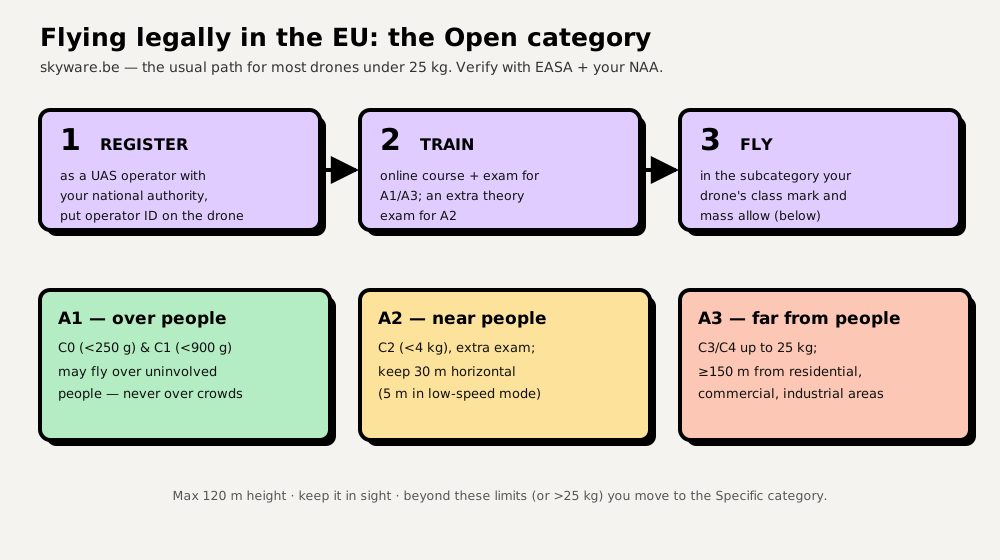
Step 1 — Register as a UAS operator
The operator is whoever is responsible for the drone (you, or your company) — distinct from the pilot who flies it. You register once with your national aviation authority (the framework is EASA-wide, but registration is national), get an operator registration number, and display it on every drone you operate. You generally must register once your drone has a camera or other sensor, or weighs 250 g or more; the lightest pure-toy drones can be exempt. One registration covers all your aircraft.
Step 2 — Train and pass the exam
No pilot's licence is needed in the Open category, but competence is:
- A1/A3 basic: a free online training course and multiple-choice exam through your national authority. This covers the great majority of recreational and light commercial flying.
- A2 additional: to fly closer to uninvolved people you pass an extra theory exam (the "A2 certificate of competency"), on top of the basic one.
Your certificate is recognised across EASA member states, so training once lets you fly throughout the EU (plus Iceland, Liechtenstein, Norway and Switzerland).
Step 3 — Fly in the right subcategory
Which subcategory you may use depends on your drone's class mark (C0–C4) and its weight:
| Subcategory | Roughly | Typical drones |
|---|---|---|
| A1 — over people | May overfly uninvolved people (never crowds/assemblies) | C0 (<250 g), C1 (<900 g) |
| A2 — near people | Keep 30 m horizontal (5 m in low-speed mode); extra exam | C2 (<4 kg) |
| A3 — far from people | ≥150 m from residential, commercial and industrial areas | C3/C4 (up to 25 kg) |
Across all of them: stay within visual line of sight, below 120 m height, out of restricted geographical zones (apps and maps show these), and never carry dangerous goods or drop anything in the Open category.
The always-true basics
- Sub-250 g is lightest-touch, not rule-free: you still register (with a camera), keep it in sight, respect height and zones, and avoid crowds.
- Insurance: often required or strongly advised — check nationally; many countries mandate liability cover.
- Geographical zones override everything: a no-fly zone near an airport or over a city is a no-fly zone whatever your certificate says.
- Minimum ages and other national specifics apply — your NAA's page is the authority.
When you leave the Open category
You move into the Specific category — which needs an operational authorisation, not just training — as soon as you break an Open-category limit: flying beyond visual line of sight, higher than 120 m, over people beyond what your subcategory allows, a drone above 25 kg, or dropping/spraying. That path runs through a risk assessment (usually SORA) and is a different, bigger undertaking — covered in our BVLOS and EASA framework guides. For most flying, though, the three steps above are the whole story.
Frequently asked questions
Do I need to register to fly a drone in the EU?
In most cases yes — you register as a UAS operator with your national aviation authority and put your operator registration number on your drones. Registration is generally required once a drone has a camera or other sensor, or weighs 250 g or more; the very lightest toy-class drones can be exempt. Rules are set by EASA and applied nationally, so check your country's authority.
Do I need a licence to fly a drone in the EU?
For the Open category you don't need a pilot's licence, but you usually need to pass online training and an exam. A1/A3 needs a basic online test; A2 (flying closer to people) needs an additional theory exam. Heavier or riskier operations move into the Specific category, which needs an operational authorisation rather than just training.
Can I fly a drone under 250 g without training in the EU?
Sub-250 g drones enjoy the lightest requirements and are often exempt from the training exam, but not from everything — you still generally register as an operator if it has a camera, keep it in sight, respect height limits and geographical zones, and never fly over crowds. 'Under 250 g' means fewer rules, not no rules.
This is independent educational content — not legal, spectrum, conformity-assessment or flight-safety advice. Rules change and differ by country. Verify current requirements with EASA, your national aviation authority, your national spectrum regulator (in Belgium, BIPT) and qualified counsel before you operate or rely on any figure here.