A freshly built drone flies "okay". A well-tuned one feels welded to your sticks — no wobble, no bounce, no drift. The gap between them is PID tuning, and while the maths can go deep, the working knowledge fits on one page. This follows on from building the drone and configuring its flight controller.
What the flight controller is actually doing
Hundreds of times a second, the gyro measures how fast the drone is rotating, the flight controller compares that to what you commanded, and it adjusts motor speeds to close the gap. The PID controller decides how it closes that gap — and it has three levers.
P, I and D in plain terms
- P — Proportional: how hard it corrects, in proportion to the error. Low P = sluggish and wallowy; high P = sharp and responsive, until it's too high and the drone shakes as it overcorrects back and forth.
- I — Integral: accounts for accumulated error, killing slow steady drift — wind pushing you off, or a slightly nose-heavy build. Too little I and the drone won't hold its attitude; too much and it feels sluggish and can bounce.
- D — Derivative: reacts to how fast the error is changing, damping and smoothing. It's the shock absorber that lets you run more P without oscillation — but D amplifies noise, so too much makes motors hot and buzzy.
The art is balance: enough P to be responsive, enough D to keep P from oscillating, enough I to hold steady — and no more of any than you need.
Reading the step response
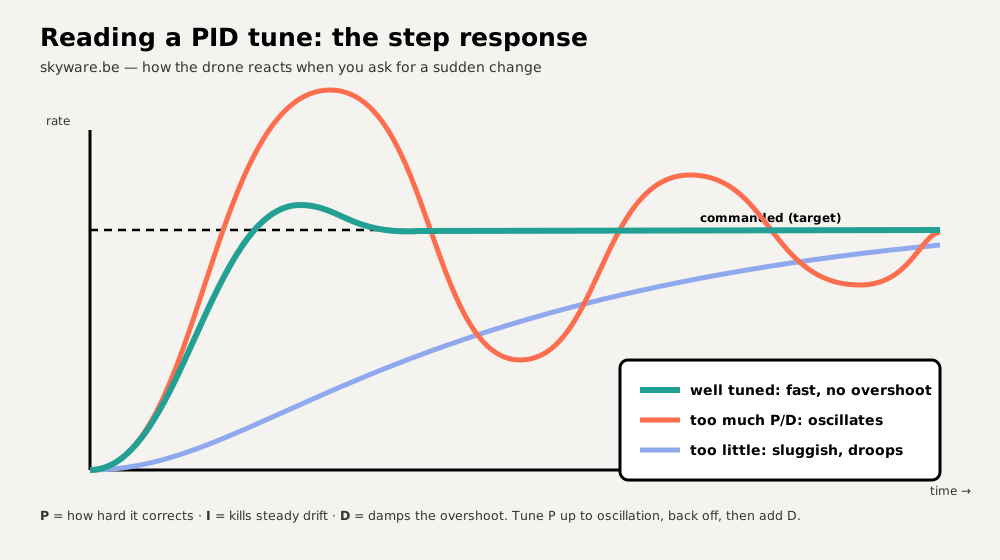
The diagram above is the whole intuition. Command a sudden change and watch how the drone reacts:
- Slow, drooping rise → too little P (and/or I): add gain.
- Overshoots then bounces back → needs more D to damp it.
- Fast oscillation / buzzing → too much P or D (or noise reaching D): back off.
- Rises fast, settles clean on target → that's the tune you want.
A safe tuning order
- Fix vibration and noise first. No PID tune survives a shaky aircraft — balance props, mount the FC properly, and set up filtering (below). This step prevents more "bad tunes" than any gain change.
- Start from a sensible preset for your size class — never a blank slate.
- Raise P until you see or hear fast oscillation, then back off ~20–30%.
- Add D to damp overshoot — until motors get warm or buzzy, then back off.
- Set I so the drone holds attitude against wind without feeling sluggish.
- Verify with logs, not just feel (below), and re-check after any hardware change.
Modern flight stacks let you run much higher gains because of filtering that removes propeller and motor noise before it reaches the D term. RPM-based notch filters — fed by bidirectional-DShot or CAN ESC telemetry — are the single biggest tuning quality-of-life upgrade. Under-filtered, you tune down to avoid hot motors; well-filtered, you keep the crisp response. Noise is a tuning problem as much as gains are.
Tune with data, not just vibes
"It feels good" is where beginners stop and experts start. Blackbox logging on Betaflight/PX4/ArduPilot records the commanded vs actual rate and the motor outputs, so you can see the overshoot, the oscillation, the noise on D — and tune the specific problem instead of guessing. It's the same log-review discipline the flight test guide preaches: measure, don't assume.
Frequently asked questions
What is PID tuning on a drone?
PID tuning adjusts the three gains — Proportional, Integral, Derivative — that decide how the flight controller corrects the drone's rotation. Good values make it respond crisply and hold steady; bad values make it sluggish, drifty or oscillating. It's the difference between a drone that flies 'okay' and one that flies locked-in.
What do P, I and D do?
P (Proportional) sets how hard the controller pushes back on an error — more P means snappier but eventually oscillation. I (Integral) removes slow, steady drift so the drone holds its commanded rate. D (Derivative) damps and smooths, resisting overshoot and oscillation. You balance the three against each other.
How do I know if my drone is badly tuned?
Tell-tale signs: fast shaking or a high-pitched buzz (too much P or D, or noise), slow wallowing and drooping after a stick input (too little), bounce-back or overshoot when you stop a manoeuvre (needs more D), or slow drift off-heading (needs more I). Blackbox logs turn these hunches into evidence.