"Add AI to the drone" is a one-line roadmap item that hides a full engineering discipline. (Want the hands-on version first? Start with the practical starter build, then come back for the full map.) Done well, AI drone integration turns an aircraft into a product: it finds the defect, tracks the target, lands on the moving deck, files the report. Done badly, it adds heat, latency and new crash modes. This guide is the end-to-end map — architecture, hardware, software, data and regulation.
What "AI on a drone" actually means
Four distinct capability families get labelled AI, and they have very different integration costs:
| Capability | Examples | Where it runs | Integration difficulty |
|---|---|---|---|
| Perception | Object detection, defect recognition, segmentation | Onboard (edge) | Medium |
| Autonomy | Obstacle avoidance, GPS-denied navigation, precision landing | Onboard, tightly coupled to flight control | High |
| Tracking & control | Follow-target, gimbal auto-tracking, visual servoing | Onboard | Medium–high |
| Analytics | Photogrammetry AI, change detection, report generation | Cloud / ground, post-flight | Low–medium |
Startups routinely promise the second row while the business case only needs the first and fourth. Be precise about which family you're integrating — everything downstream follows from it.
The reference architecture
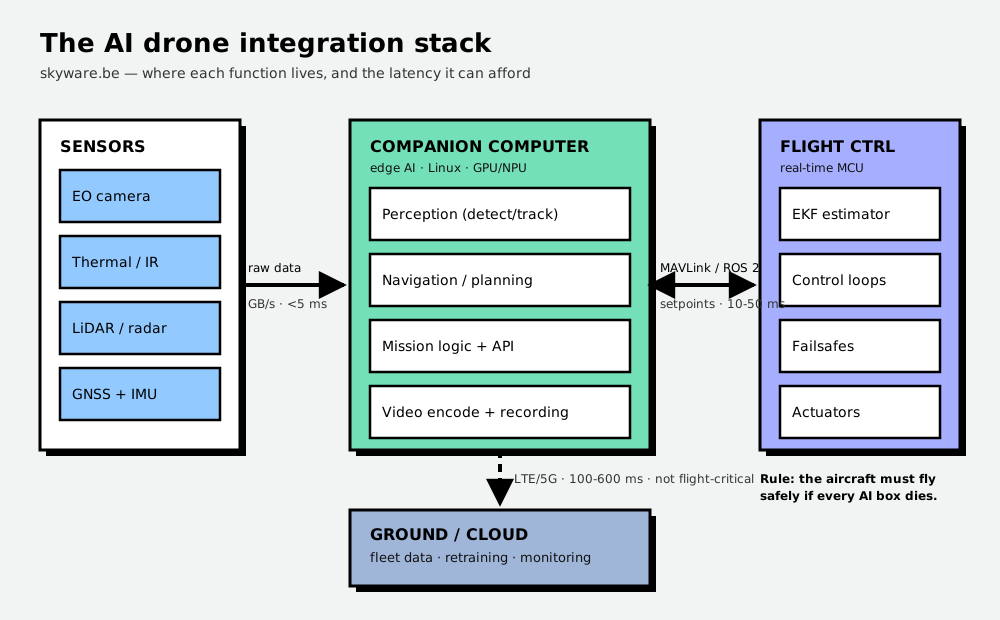
The architecture rule that keeps aircraft out of trees: AI proposes, the flight controller disposes. Models run on a Linux companion computer and send bounded commands (velocity setpoints, waypoints, gimbal angles) to a conventional flight controller, which enforces limits, geofences and failsafes exactly as if a human were flying. The aircraft must remain flyable and landable with every AI process dead — that single design boundary is what makes the safety case, the SORA, and your test program tractable.
Edge vs cloud: decide by latency, not fashion
| Function | Latency budget | Verdict |
|---|---|---|
| Obstacle avoidance | < 50 ms | Edge, always |
| Visual tracking / servoing | < 100 ms | Edge |
| Detection alerts to operator | < 1 s | Edge inference, streamed result |
| Map/report generation | Minutes | Cloud, post-flight |
| Model retraining | Days | Cloud, from fleet data |
Cellular round trips run 100–600 ms with dropouts (see BVLOS datalinks) — nothing flight-relevant may depend on them. The productive pattern: infer at the edge, learn in the cloud, with the datalink carrying results and curated data, not raw decisions.
Hardware: the compute-power-thermal triangle
Sizing rules from the companion computer guide apply doubled: write the workload spec first ("YOLO-class detection, 1080p, 30 FPS, <50 ms") and shop with it. Current practice: Jetson Orin-class modules for serious perception (20–100+ TOPS, 7–25 W), NPU accelerators (Hailo, Coral) boosting small SBCs at 2–5 W for single-model workloads. Two integration killers to design out early: thermal throttling (a sealed pod in summer sun will halve your frame rate exactly when the customer is watching — duct real airflow) and camera choice (a global-shutter camera on a stiff mount buys more accuracy than the next GPU tier; rolling shutter plus vibration feeds models artefacts they never unlearn).
Software stack that survives contact with production
- Interface: ROS 2 with PX4's uXRCE-DDS bridge, or MAVSDK/MAVLink on either stack — resist bespoke protocols.
- Inference runtime: export models to an optimised format (TensorRT, ONNX Runtime, OpenVINO) — typically 2–5× throughput over running the training framework onboard.
- Deployment: containerised autonomy stack, versioned like firmware, A/B rollback, fleet-wide over-the-air updates. A hand-configured Jetson is technical debt with propellers.
- Watchdogs: the flight controller monitors companion heartbeat; the mission degrades gracefully — hold, return or continue-without-AI per phase, all of it exercised in flight test.
The data pipeline is the actual product
Models are frozen snapshots of your data; competitors can buy the same Jetson but not your dataset. Treat the loop as core IP: every flight logs imagery + telemetry with PPS-synced timestamps; edge cases (low confidence, operator overrides) get flagged for labelling; retrained models pass a fixed evaluation set plus regression flights before fleet rollout. Budget honestly: teams that ship report spending well over half their AI effort on data and evaluation, not model architecture.
Regulation, briefly
Two frameworks meet on your aircraft. EASA treats autonomous functions through the operational risk path — your SORA must describe what the autonomy does and prove the failure behaviour. The EU AI Act layers horizontal AI rules on top, with aviation-specific carve-outs for EASA-regulated products. The engineering posture that satisfies both: keep AI advisory or bounded, keep the deterministic safety chain AI-free, and document the boundary.
The integration checklist
- Define the capability family and a measurable spec (model, resolution, FPS, latency, accuracy).
- Fix the safety boundary: what the AI may command, what the FC enforces, what happens on AI death.
- Select camera and mounting before compute; then size compute with 30% headroom; then design the thermal path.
- Stand up the data pipeline (logging, labelling, evaluation) before polishing the model.
- Bench-test the thermal corner: full inference, zero airspeed, max sun.
- Flight-test the failure modes: kill the AI process mid-mission, on purpose, per the test program.
- Ship the update mechanism with aircraft one — model v2 is coming whether you planned for it or not.
AI drone integration succeeds when it's treated as systems engineering, not model shopping: a bounded autonomy architecture, honest latency budgets, a thermal design that holds 30 minutes into hover, and a data flywheel that makes aircraft number 100 smarter than aircraft number 1. The model is the easy part.
Frequently asked questions
What is AI drone integration?
AI drone integration is the engineering work of putting artificial intelligence — perception, navigation, tracking or analytics models — onto an unmanned aircraft system: selecting compute hardware, connecting it to sensors and the flight controller, building the data and model-update pipeline, and keeping the aircraft safe when the AI fails.
Does drone AI run onboard or in the cloud?
Anything that steers the aircraft or must react in under ~200 ms runs onboard (edge AI on a companion computer). Heavy analytics, model training and fleet intelligence run in the cloud after or during flight. Almost every serious system is a hybrid of both.
What hardware do I need for AI on a drone?
A companion computer with an inference accelerator — NVIDIA Jetson-class modules are the de facto standard, with lighter NPU options (Hailo, Coral) for smaller airframes — sitting next to, never instead of, a conventional flight controller. Budget 7–25 W of power and the thermal design to dissipate it.
Is AI on drones regulated in Europe?
Two frameworks touch it: EASA's aviation rules (your operational authorisation must account for autonomous functions) and the EU AI Act for AI systems, with drones under EASA product rules treated through the aviation framework. Design so the aircraft remains safe with the AI disabled — that boundary simplifies both.