A 3D printer is the single most useful tool a drone builder can own — mounts, housings, ducts and brackets on demand, iterated in an afternoon. But the material choice matters far more on an aircraft than on a desk ornament: parts here take vibration, impact, sun and heat. This guide covers what to print in what, and what to leave to carbon fibre. It pairs with the frame materials guide and the build roadmap.
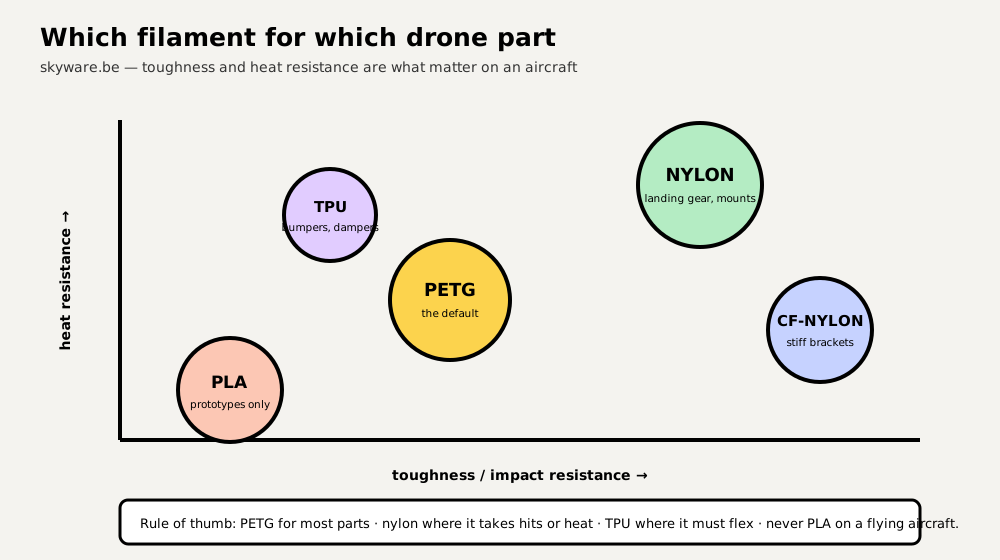
The materials, ranked by usefulness on a drone
| Filament | Good for | Watch out |
|---|---|---|
| PETG | The default for ~90% of parts: mounts, housings, plates, antenna holders | Softens around 80 °C — marginal right against a hot VTX |
| Nylon (PA) | Landing gear, motor mounts, anything taking repeated impact; far tougher than PETG | Needs a hot nozzle, enclosure and genuinely dry filament — it absorbs moisture greedily |
| CF-nylon | Stiff brackets and arms where deflection matters | Stiffer but less impact-tough than plain nylon; needs a hardened nozzle |
| TPU | Bumpers, feet, camera and FC vibration dampers, cable guards | Prints slowly; too soft for structure |
| PLA | Bench prototypes and test fits only | Brittle, and deforms in a hot car or in the sun. Not for flying parts |
Print settings that survive flight
A drone part fails at its layer lines, so settings matter as much as material:
- Perimeters over infill. 4–5 perimeters with 20–30% infill beats 2 perimeters with 60% — strength lives in the walls.
- Print orientation is a design decision. Layers separate under tension; orient parts so loads run along layers, not across them. A motor mount printed flat is far stronger than the same part printed upright.
- Hotter, slower, for layer adhesion. Run the top of the material's temperature range and slow down on structural parts.
- Dry your filament. Wet nylon and PETG print weak, stringy and brittle. For nylon this isn't optional.
- Add fillets. Sharp internal corners are where cracks start — a 2 mm fillet is free strength.
What to print — and what not to
Print freely: camera and GPS mounts, antenna holders, electronics trays, battery straps and pads, ducts, light housings, tool jigs, prototypes of everything. This is where printing genuinely accelerates a build.
Print with care: landing gear (nylon), arms and plates on small aircraft, payload housings — test these hard before trusting them.
Don't print: primary structure on larger aircraft (that's carbon fibre's job — see frame materials), propellers (balance and strength requirements are beyond FDM — see propellers), or anything whose failure drops the aircraft and where you can buy a proven part instead.
Printed parts are seductively easy to add, and grams accumulate silently. Weigh each printed part and put it in the mass budget — "just a bracket" ×12 is a payload you gave away. Design for the lightest part that survives, not the strongest part you can print: lightening holes, thin walls with good perimeters, and deleting parts entirely are all better than more infill.
Heat: the failure nobody plans for
The most common printed-part failure isn't impact — it's a black part in direct sun next to a warm video transmitter or motor, quietly sagging. Check what's hot on your aircraft, keep PETG away from it, use nylon where you can't, and always test a new design on a hot day before you trust it.
Frequently asked questions
What is the best filament for drone parts?
PETG for most parts — it's tough enough, prints easily and resists heat far better than PLA. Nylon (or carbon-fibre nylon) for parts that take repeated impacts or heat, like landing gear and motor mounts. TPU for anything that should flex, such as bumpers and vibration dampers. Avoid PLA on anything that flies.
Can you 3D print a whole drone frame?
For small, light drones yes — printed frames are common on sub-250 g builds and micro quads. On bigger aircraft, the primary structure (arms and main plates) is normally carbon fibre, with printing used for mounts, housings, ducts and brackets around it. Layer adhesion under vibration is the limiting factor.
Why shouldn't I use PLA for drone parts?
PLA is stiff but brittle and softens around 55-60 °C — a black PLA part in a parked drone on a sunny day can deform on its own. It cracks on impact instead of absorbing it. It's excellent for test-fitting parts on the bench, and a poor choice for anything that has to survive a landing.