Every counter-UAS sensor has a blind spot: RF misses the silent drone, radar loses the small-slow-low one, acoustic runs out of range, optical needs a cue and clear air. Sensor fusion is the discipline of combining them so the system as a whole has no single blind spot — and, as a bonus, tracks better and false-alarms less than any sensor alone. It's also the clearest example of AI applied to drones, pointed at defence rather than flight.
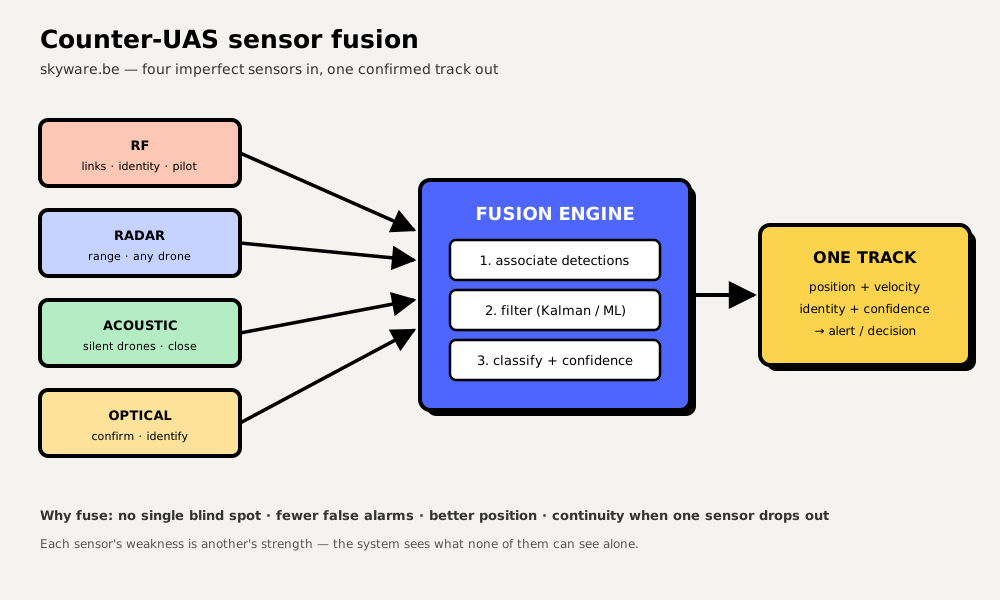
What fusion actually does
Fusion is not "show four sensor feeds on one screen" — that just multiplies the operator's false alarms. Real fusion answers three questions continuously:
- Association: do these detections, from different sensors at slightly different times, belong to the same object? (The RF hit, the radar blip and the camera box — one drone or three?)
- Estimation: given the associated detections, what is the object's best-estimate position, velocity and heading right now?
- Classification and confidence: is it a drone, which kind, and how sure are we?
The classical backbone: associate, then filter
The engineering core has been stable for decades and is worth understanding before adding AI. Data association matches incoming detections to existing tracks (or starts new ones). Then a recursive filter — the Kalman filter and its non-linear cousins, or particle/Bayesian filters — fuses each new measurement with the track's prediction, weighting each sensor by its expected accuracy. This is the same estimator family that runs inside a drone's own EKF; counter-UAS just fuses external sensors instead of onboard ones. The filter is what lets a radar's good range and a camera's good bearing combine into a position better than either.
Where the accuracy gains come from
| Gain | Mechanism |
|---|---|
| Fewer false alarms | Require corroboration: a track confirmed by 2+ independent sensors is almost certainly real; single-sensor blips are down-weighted |
| No blind spots | The silent drone RF misses is caught by radar/acoustic/optical; the small-slow-low target radar loses is caught by RF or acoustic |
| Better position | Combine each sensor's strong axis — radar range + camera bearing + RF identity |
| Continuity | When one sensor drops the target (occlusion, range), the track survives on the others |
| Identity + intent | RF names the model and finds the pilot; optical confirms payload; together they support a real decision |
Where AI is changing it
Machine learning is moving from just classifying single-sensor data (is this radar return a drone or a bird? is this audio a drone?) toward learned fusion — models that combine raw or semi-processed data from multiple sensors and output tracks and classifications directly, learning correlations a hand-built filter misses. The trade is the usual one: learned fusion can be more accurate and more robust to messy real-world data, but it needs large, well-labelled multi-sensor datasets and is harder to certify and explain than a Kalman filter whose behaviour you can derive. Most fielded systems today are hybrids: classical tracking with ML doing classification and association.
Fusion turns a collection of individually unreliable sensors into a system that is more than their sum: it sees what each one misses, trusts what several confirm, and tracks better than the best single sensor. Accuracy in counter-UAS is less about a better sensor than about combining honest, imperfect ones well — which is exactly why this is an AI and estimation problem, not a hardware shopping list.
Starting point
If you're building toward fusion: get each sensor producing clean, time-stamped detections first (garbage in, garbage fused), agree a common coordinate frame and clock, then start with classical association + Kalman tracking before reaching for learned fusion. The detection systems overview covers the sensors that feed it, and the public standards for how professional systems format fused tracks (e.g. EUROCONTROL's ASTERIX) are a useful map of what "done" looks like.
Frequently asked questions
What is sensor fusion in counter-UAS?
Sensor fusion combines the outputs of several drone-detection sensors — RF, radar, acoustic, optical — into a single, more reliable track than any one sensor could produce. It associates detections that belong to the same object, filters out noise, and fills each sensor's blind spots with the others' strengths.
How does fusion improve detection accuracy?
Two ways. It raises confidence and cuts false alarms — a target confirmed by RF and radar and a camera is almost certainly real, whereas any one sensor alone false-alarms. And it improves the track: combining a radar's range with a camera's precise bearing gives a better 3D position than either alone.
What algorithms are used for drone sensor fusion?
Classically, data association (matching detections to tracks) plus recursive estimators — Kalman filters and their non-linear variants, or particle/Bayesian filters — to maintain each track. Increasingly, machine learning handles classification and association, especially for fusing camera and radar data.
This is independent educational content — not legal, spectrum, conformity-assessment or flight-safety advice. Rules change and differ by country. Verify current requirements with EASA, your national aviation authority, your national spectrum regulator (in Belgium, BIPT) and qualified counsel before you operate or rely on any figure here.