RF detection is where most counter-UAS programs start, because it's passive, comparatively cheap, and it exploits a fact about nearly every drone: to be flown, it usually has to talk. This guide covers how RF sensing listens in, how it locates a drone and its pilot, and the one scenario where it goes completely deaf.
What there is to listen to
A typical drone radiates several tell-tale signals, each covered in our radio links and video transmission guides:
- Control link (C2): the handset↔drone command channel, usually 2.4 GHz or 5.8 GHz with frequency hopping.
- Video downlink: often the loudest, most detectable emission — analog or digital FPV on 5.8 GHz, or the drone's own protocol.
- Telemetry / Wi-Fi / Remote ID: lower-rate links, and in the EU/US the broadcast Remote ID beacon, which an RF sensor can simply decode to get identity and position for free.
From signal to identity: protocol libraries
Raw energy on 5.8 GHz could be a drone, a security camera or a wireless HDMI sender. What turns an RF detector from a noise meter into a drone detector is a protocol library: fingerprints of how specific drone families hop, packetise and modulate. Match the fingerprint and the system reports "DJI Mavic 3, control + video" rather than "something on 5.8 GHz." The quality of that library — and how fast it's updated as new drones ship — is much of what you pay for in a commercial RF system.
Locating the drone (and the pilot)
Detection tells you a drone exists; operators want to know where. RF gives two levels:
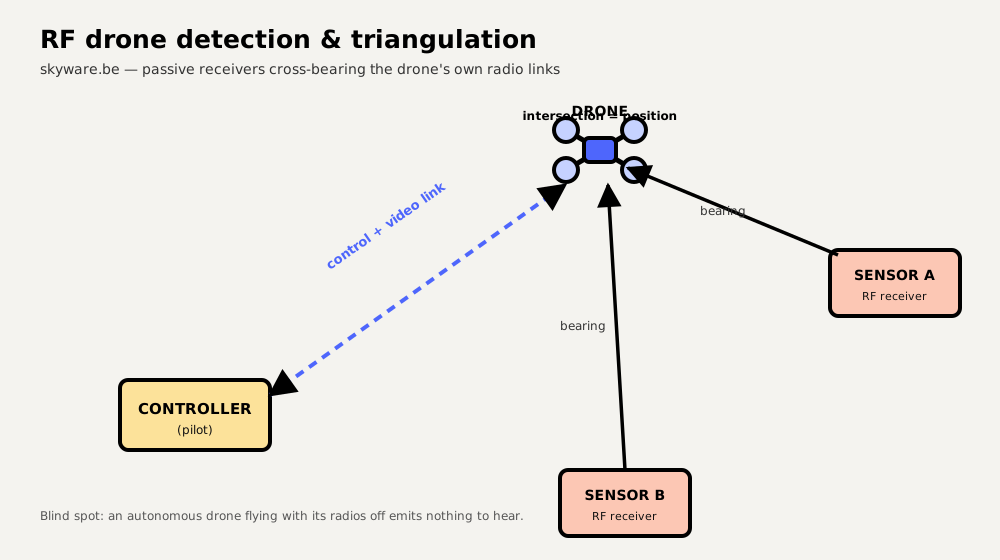
- Direction finding (DF): a single multi-antenna sensor estimates the bearing to the emitter.
- Triangulation: two or more sensors at known locations cross their bearings to fix a 2D position — the geometry in the diagram above.
Because the controller transmits too, RF is the only modality that can also locate the operator — a decisive advantage for law enforcement, where finding the person matters more than downing the aircraft.
The hard limits
- The autonomous blind spot. A drone flying a pre-loaded GPS mission with its radios off emits nothing. RF hears silence. This is the single most important thing to understand about RF detection — and the reason it must be paired with acoustic, radar or optical sensing.
- Urban RF soup. Cities are saturated with 2.4/5.8 GHz traffic; separating a drone from a thousand Wi-Fi devices raises false-alarm rates and shortens effective range.
- Encryption and novelty. New or custom protocols aren't in the library until someone adds them; encrypted or spread-spectrum links can defeat fingerprinting.
- Range is signal-dependent. A loud video downlink might be caught at 5 km; a whisper-quiet control link far less. Published ranges assume a cooperative, chatty drone.
Passively receiving RF to detect drones is generally permissible. Transmitting to jam or spoof a drone's links is a different legal universe — usually restricted to specific government users and often outright illegal otherwise. Keep detection and mitigation cleanly separated in any plan, and check the rules with your spectrum regulator (in Belgium, BIPT).
Where RF fits
Treat RF as the early-warning tripwire: cheap, wide, passive, and able to name most threats and find their pilots — then hand off to sensors that don't share its deafness to silent drones. The detection systems overview shows how the layers combine, and sensor fusion is what makes RF's early cue trigger a camera before the drone is overhead.
Frequently asked questions
How does RF drone detection work?
RF sensors passively listen across the bands drones use — 2.4 and 5.8 GHz, 900 MHz, 433 MHz — for the signatures of control and video links. Software matches the signal against a library of known drone protocols to detect and often identify the model, and multiple receivers locate it by direction finding or triangulation.
What frequencies do drones use?
Most consumer and commercial drones use 2.4 GHz and 5.8 GHz for control and video, with some using 900 MHz (US) or 868 MHz (EU) and 433 MHz for long-range telemetry, plus LTE/5G for beyond-line-of-sight. RF detectors scan these bands for the characteristic hopping and packet patterns.
Can RF detection find the drone pilot?
Often, yes. Because the controller also transmits, a direction-finding RF system can locate both the drone and the operator, which is valuable for law enforcement. This is a real advantage RF has over radar, acoustic and optical sensing, none of which see the pilot.
This is independent educational content — not legal, spectrum, conformity-assessment or flight-safety advice. Rules change and differ by country. Verify current requirements with EASA, your national aviation authority, your national spectrum regulator (in Belgium, BIPT) and qualified counsel before you operate or rely on any figure here.