Acoustic detection is the humblest counter-UAS sensor and, in the right spot, one of the most useful: it's cheap, entirely passive, and it hears the one thing that defeats RF detection — a drone flying in radio silence. This guide covers how listening for propellers actually works, and why range is both its limitation and, sometimes, exactly enough.
The signature: why drones sound like drones
A multirotor's noise is dominated by its propellers — the blade-passing frequency and its harmonics, sitting on the broadband whoosh of the motors (the physics is in the propeller guide). That produces a characteristic spectral pattern — a set of tones at predictable spacings — that's quite unlike traffic, wind or birds. Detection software learns these patterns; the tones even shift with throttle, which can hint at what the drone is doing.
From sound to direction: the microphone array
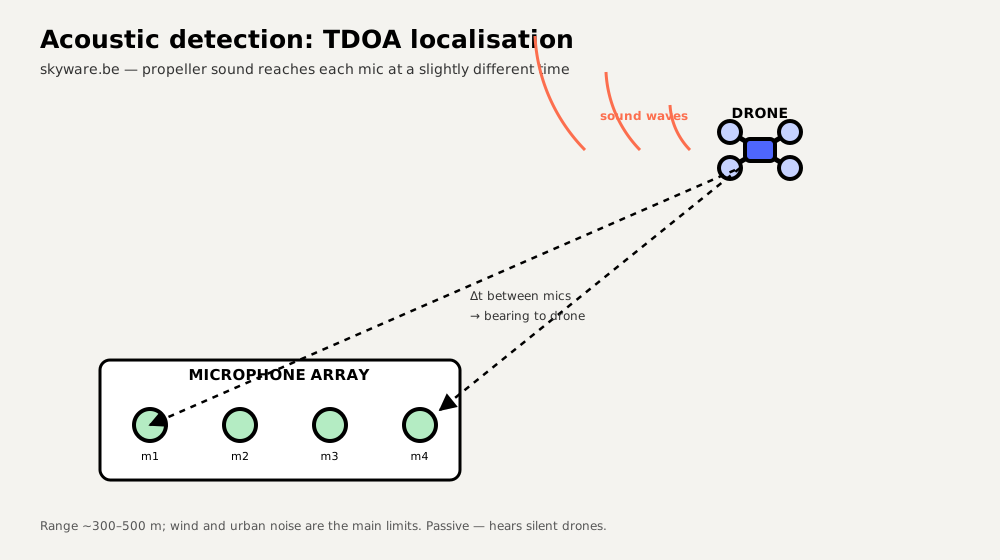
One microphone can detect; it can't locate. An array of several microphones, centimetres to metres apart, can — because sound arrives at each mic at a slightly different time. Measuring those time differences of arrival (TDOA) yields the bearing to the source, and multiple arrays (or a large one) can cross bearings into a rough position and altitude. It's the same triangulation idea as RF direction finding, done with pressure waves travelling at ~343 m/s instead of radio at the speed of light — which, helpfully, makes the timing differences large and measurable with cheap hardware.
Classification: telling a drone from a lawnmower
The hard part isn't hearing a sound — it's deciding whether it's a drone. Modern systems feed array audio into a machine-learning classifier trained on drone signatures versus everything else (the same edge-AI toolkit used onboard drones, pointed the other way). Good training data is the whole game: a classifier that has never heard a particular drone, or a particular wind condition, will miss or false-alarm. Libraries like librosa handle the feature extraction; the dataset is what you actually invest in.
The real limits: range and noise
- Range. Sound intensity falls with the square of distance and is absorbed by air, so practical detection is ~300–500 m and shrinks fast for quiet drones. This is a close-in sensor, full stop.
- Wind and weather. Wind noise across the microphones is the classic killer; rain and temperature gradients bend and muffle sound. Good windscreens and array placement matter enormously.
- Urban din. Traffic, HVAC and crowds raise the noise floor and hide the signature — the same problem RF has in cities, in a different medium.
- Bigger/faster drones climb out of range quickly; acoustic favours the low, slow, close threat.
Short-range, low-altitude, autonomous threats near a fixed sensitive point — a prison wall, a substation, a VIP stage. There, RF may hear nothing and radar may lose the small-slow-low target in clutter, but a cheap microphone array hears the props coming over the fence. Acoustic isn't a perimeter for a city; it's a superb tripwire for a wall.
Fitting it into the system
Acoustic pairs naturally with optical: the array's bearing cues a camera to the right patch of sky for confirmation and identification, covering acoustic's inability to say which drone. Combined through sensor fusion with RF and radar, its narrow but RF-proof coverage plugs a specific, important hole. See the detection systems overview for the full picture.
Frequently asked questions
How does acoustic drone detection work?
A microphone array picks up the distinctive whine of a drone's propellers and motors. Software classifies the sound against known drone signatures, and the tiny differences in arrival time between microphones (TDOA) give the direction — and, with enough spacing, an approximate position.
How far can acoustic sensors detect a drone?
Realistically 300–500 metres in good conditions, less in wind or noisy environments. Sound falls off quickly and is easily masked, so acoustic detection is a short-range, low-altitude layer rather than a wide-area sensor.
Why use acoustic detection if the range is short?
Because it is passive, cheap, and hears autonomous drones that emit no radio signal — RF detection's biggest blind spot. Around sensitive close-in points like prison walls or a VIP venue, a short-range sensor that catches the silent drone is exactly what's needed.
This is independent educational content — not legal, spectrum, conformity-assessment or flight-safety advice. Rules change and differ by country. Verify current requirements with EASA, your national aviation authority, your national spectrum regulator (in Belgium, BIPT) and qualified counsel before you operate or rely on any figure here.