"Autonomous" covers everything from flying a pre-set GPS route to threading through a forest with no satellites at all. Under the buzzword is a surprisingly clean structure — the same three layers, whatever the drone. This guide maps that stack, shows how GPS-denied flight works, and where AI actually fits.
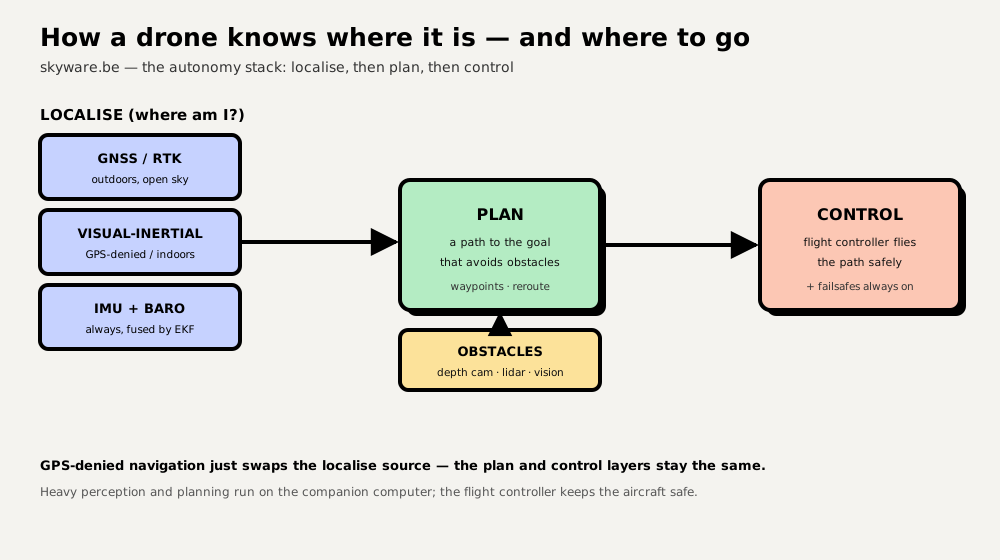
The three-layer stack
- Localise — "where am I?" Fuse position sources into one best estimate. Outdoors that's GNSS/RTK blended with the IMU and barometer in the flight controller's EKF; indoors or GPS-denied, cameras take over (below).
- Plan — "how do I get to the goal?" Choose a path — a line of waypoints, or a route computed on the fly to dodge obstacles.
- Control — "fly it safely." The flight controller executes the path with its stabilisation and failsafes, exactly as covered in the build guide.
The key insight: only the localise layer changes between outdoor GPS flight and indoor GPS-denied flight. Plan and control stay the same.
Level 1: GPS waypoint missions
The most common autonomy: you draw waypoints on a map, the drone flies them. Every PX4/ArduPilot aircraft does this, and it's how mapping, inspection and survey flights run. It's reliable and boring in the best way — but it depends entirely on GNSS, so it fails exactly where satellites do: indoors, in urban canyons, under structures, or when jammed.
Level 2: GPS-denied navigation
When there's no GPS, the drone estimates its own motion visually. Visual-inertial odometry (VIO) tracks how the scene shifts between camera frames and fuses that with the IMU's acceleration and rotation — like counting your steps in the dark while feeling the walls. Push further and you get SLAM (Simultaneous Localisation and Mapping), which builds a map of the space while locating within it. This is what lets drones fly inside buildings, under bridges and through GPS-jammed areas — and it runs on the companion computer, feeding a position into the flight controller as if it were GPS.
Level 3: obstacle avoidance
Sensing and dodging obstacles closes the loop from "follow a path" to "find a safe path." Sensors range from simple ultrasonic and single-beam rangefinders to depth cameras, lidar and computer vision. It's genuinely hard: thin objects (wires, branches) are nearly invisible, fast approaches leave no reaction time, and false stops are as annoying as misses. Treat avoidance as an aid with limits, not a guarantee — and keep your failsafes independent of it.
AI is transforming the localise and sense layers: learned visual odometry, semantic understanding of the scene, robust obstacle detection. But control stays deterministic — a classic, provable flight controller flies the aircraft, because you must be able to guarantee it fails safe. The winning pattern, again: AI perceives and proposes; the flight controller disposes. It's the throughline of every AI-on-drones guide here.
Building toward autonomy
Start where the risk is lowest: GPS waypoint missions on a well-built, well-tuned aircraft. Add vision for perception. Reach for VIO/SLAM only when the mission truly needs GPS-denied flight — it's a serious engineering program, not a checkbox. And test every autonomous behaviour, including its failure, the way the flight test guide insists: deliberately, at altitude, over ground that forgives.
Frequently asked questions
How do autonomous drones navigate?
Through a three-layer stack: localise (work out where it is, from GNSS, cameras and inertial sensors), plan (choose a path to the goal that avoids obstacles), and control (fly that path safely). Swapping the localisation source is what lets the same drone navigate outdoors on GPS or indoors without it.
How does a drone fly without GPS?
By visual-inertial odometry: cameras track how the scene moves while the IMU measures acceleration and rotation, and fusing the two estimates the drone's motion without satellites. This GPS-denied navigation is what lets drones fly indoors, under bridges, or where GPS is jammed.
Do autonomous drones avoid obstacles automatically?
Increasingly yes — using depth cameras, lidar or computer vision to sense obstacles and reroute around them. It's genuinely hard (thin objects like wires and fast approaches are the tough cases), so treat any avoidance system as an aid with limits, not a guarantee, and keep failsafes independent of it.