The payload is the whole point of the flight. Everything else — frame, motors, battery, autopilot — exists to get it into position. This guide maps the payload families drones actually carry, what each weighs and costs you in flight time, and how to choose without painting yourself into a corner. For the engineering of bolting one on, see the payload integration checklist.
A UAV payload is anything the drone carries that isn't required to fly it. Payloads fall into four families: imaging (visible, zoom, thermal, gimbals), measurement (LiDAR, multispectral, gas, magnetometer), carry (cargo, winch, spray tank) and connectivity (relays, lights, speakers). A well-designed electric multirotor carries roughly 20–30% of its take-off weight as payload.
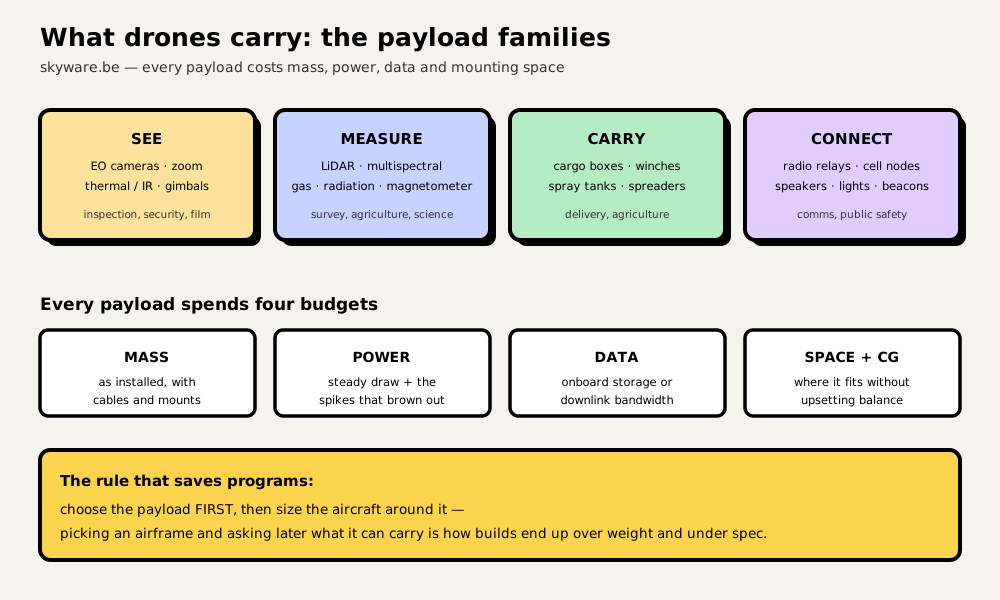
The four payload families
| Family | Typical payloads | Weight | Used for |
|---|---|---|---|
| See | EO camera, zoom block, thermal/IR, EO/IR gimbal | 0.1–2 kg | Inspection, security, film, search |
| Measure | LiDAR, multispectral, gas sniffer, radiation, magnetometer | 0.3–4 kg | Survey, agriculture, environmental, science |
| Carry | Cargo box, winch, spray tank, spreader | 1–40 kg | Delivery, logistics, agriculture |
| Connect | Radio relay, cellular node, speaker, searchlight, beacon | 0.2–3 kg | Comms, public safety, events |
Imaging payloads: the default
Most commercial drones carry a camera of some kind. The meaningful splits are visible vs thermal (thermal finds heat — failing solar cells, insulation gaps, people at night — but resolves far less detail), fixed vs zoom (zoom keeps the aircraft at a safe standoff), and fixed-mount vs gimbal (a stabilised gimbal is what makes long focal lengths usable at all). Dual EO/IR pods are the inspection standard because thermal findings need visible context to be interpretable. Details and selection criteria are in the camera payloads guide.
Measurement payloads: when a picture isn't enough
These produce data, not imagery. LiDAR measures geometry directly and sees through vegetation gaps — the reason it beats photogrammetry for ground models under canopy (the full comparison). Multispectral and hyperspectral sensors read plant health and material signatures in bands the eye can't see. Gas, radiation and magnetometer payloads put an instrument somewhere a person shouldn't stand. All of them share one demand: they only produce trustworthy data if position and time are tightly known, which is why they pair with RTK positioning and PPS time sync.
Carry payloads: the mass problem
Cargo, winches, spray tanks and spreaders are the heaviest things drones lift, and they bring two problems no sensor has: the mass changes in flight (a spray tank empties, a package is released), shifting weight and centre of gravity mid-mission, and the release mechanism is safety-critical. That combination is why delivery mechanisms are their own engineering discipline, and why payload capacity deserves honest arithmetic before anything is promised.
Connectivity payloads: the quiet category
Sometimes the job is to be infrastructure: a radio relay extending a network over terrain, a cellular node restoring coverage after a disaster, a loudspeaker or searchlight for public safety. These are low-glamour, high-value payloads with an unusual profile — modest mass, but often high power draw and long loiter requirements, which pushes them toward tethered or high-endurance platforms.
The four budgets every payload spends
- Mass — as installed, including cables, mounts and covers. Datasheet mass is never installed mass (mass budget).
- Power — steady draw plus the transients that brown out shared rails; give payloads their own protected supply.
- Data — onboard storage, or downlink bandwidth at range if it must be seen live.
- Space and CG — where it physically fits without pushing the centre of gravity outside the tuned envelope.
The single most expensive mistake in UAV programs is picking an airframe and then asking what it can carry. Start from the deliverable the customer pays for, choose the payload that produces it, then size the aircraft — propellers, motors, battery, endurance — around that payload's four budgets. Everything in the build roadmap follows from this order.
Modular or fixed?
A swappable payload interface (mechanical pattern, power spec, data contract) turns one airframe into several products and makes third-party payload partnerships possible. It costs weight, connectors and design effort up front. Fixed integration is lighter, cleaner and cheaper for a single-mission aircraft. If you expect more than one payload in the product's life — most teams do — define the interface early, because retrofitting modularity is far harder than designing it in.
Frequently asked questions
What is a drone payload?
A drone payload is everything the aircraft carries that isn't needed to fly it — cameras, thermal sensors, LiDAR scanners, gas detectors, cargo, spray tanks or radio relays. The airframe, motors, battery and flight electronics are not payload; the payload is the reason the flight happens at all.
What are the main types of UAV payload?
Four families: imaging payloads (visible cameras, zoom, thermal, gimbals), measurement payloads (LiDAR, multispectral, gas, radiation, magnetometers), carry payloads (cargo boxes, winches, spray tanks, spreaders) and connectivity payloads (radio relays, cellular nodes, speakers and lights).
How heavy is a typical drone payload?
Roughly: a compact mapping camera 100–300 g, a professional EO/IR gimbal 0.5–2 kg, a survey LiDAR unit 1–4 kg, a delivery box 1–5 kg, and an agricultural spray tank 10–40 kg when full. A well-designed electric multirotor carries about 20–30% of its take-off weight as payload.
How do I choose the right payload for my drone?
Work backwards from the deliverable. Define what the customer needs (a defect report, a point cloud, a delivered package), pick the sensor or device that produces it, then size the aircraft around that payload's mass, power, data and mounting needs — never the other way around.