"How much can it lift?" is the most common question about any drone build — and the one most often answered with a guess. The real answer is a short calculation you can do before buying a single part, and it's the same arithmetic whether you're strapping on a camera or designing a delivery aircraft. Here it is, with the trade-offs that spec sheets leave out.
The calculation
Three steps:
- Total thrust. Take the maximum thrust of one motor with your chosen propeller and battery voltage — from the manufacturer's thrust table, not from hope — and multiply by the number of motors.
- Halve it. The working standard is 2:1 thrust-to-weight: total thrust should be at least twice the all-up weight, so hover sits near half throttle. That reserve isn't luxury; it's what you steer, fight wind and recover with.
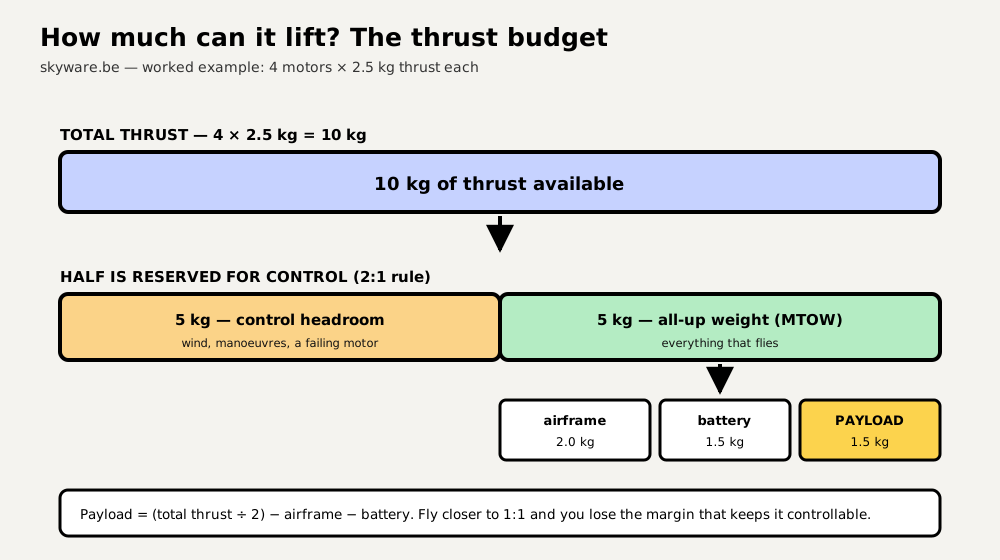
- Subtract the aircraft. Payload = (total thrust ÷ 2) − airframe − battery.
Worked example (the diagram above): four motors × 2.5 kg = 10 kg total thrust → 5 kg maximum all-up weight → minus a 2 kg airframe and a 1.5 kg battery → 1.5 kg of payload. Note how a 10 kg-thrust aircraft carries 1.5 kg, not 10 kg. That gap is where most optimistic estimates die.
Why 2:1, and when to deviate
| Thrust-to-weight | Feels like | Use for |
|---|---|---|
| 1.5:1 | Sluggish; little margin in wind or a gust | Absolute maximum-lift flights, calm conditions, experienced crew |
| 2:1 | Stable, controllable, hover at ~50% throttle | The default for working aircraft |
| 3:1+ | Sporty and responsive | FPV, agile flying, heavy wind, VTOL transitions |
On multirotors with 6+ motors there's a second reason for margin: surviving a motor failure needs the remaining motors to hold the aircraft up, which they can only do with headroom (see failsafes & redundancy).
Payload always trades against flight time
Hover power scales roughly with weight1.5, so 20% more mass costs about 30% more power. Payload and endurance are therefore a single spec, never two: "2 kg payload" and "35 minutes" are only meaningful together. Any datasheet quoting maximum payload and maximum endurance is quoting two different flights. The full arithmetic is in the endurance calculation guide, and the discipline for tracking it all is the mass budget.
Published thrust figures come from a clean bench at sea level, ~20 °C, with a fresh battery. Real aircraft lose several percent to airframe blockage and prop-wash interference, and more to heat and altitude — air density drops ~3.5% per 300 m, and a hot summer day costs more. Derate by ~10–15% for design, then verify on your own thrust stand. Hot-and-high with a full payload is where under-margined aircraft stop climbing.
Typical capacities, for orientation
- Consumer camera drones: a few hundred grams to ~2 kg (many carry nothing beyond their own camera).
- Professional/industrial multirotors: ~2–10 kg, the workhorse range for sensor payloads and LiDAR.
- Heavy-lift platforms: 20 kg+, with specialist aircraft going far higher — at a steep cost in size, price and regulatory category (25 kg MTOM is a hard regulatory line in Europe — see EASA rules).
Designing for a specific payload? Start from the payload and work backwards through the mass budget and motor sizing — choosing an airframe first and asking what it can lift afterwards is how programs end up 18% over target.
Frequently asked questions
How much weight can a drone carry?
It depends entirely on the aircraft: consumer camera drones carry a few hundred grams to ~2 kg, professional multirotors typically 2–10 kg, and dedicated heavy-lift platforms 20 kg or more. What matters for your own build is the calculation: payload = (total motor thrust ÷ 2) − the empty weight of the drone and battery.
How do I calculate my drone's payload capacity?
Add up the maximum thrust of all motors (from the manufacturer's thrust table with your propeller), halve it to keep the standard 2:1 thrust-to-weight margin, then subtract the airframe and battery weight. What's left is usable payload. Design conservatively — thrust tables are bench figures in ideal conditions.
Why does carrying more payload reduce flight time so much?
Because hover power rises faster than weight — roughly with weight to the power 1.5. Adding 20% more mass costs about 30% more power, so flight time drops disproportionately. This is why payload and endurance always have to be specified together, never separately.