Swarms have moved from research demos to a genuine engineering discipline — and in 2026 they're one of the most active areas in drone development, pushed hard by defence, disaster response and infrastructure inspection. Strip away the hype and a swarm is a distributed systems problem that happens to fly. Here's how coordination actually works, and what's still hard.
Fleet vs swarm
Not every group of drones is a swarm. A drone light show flies hundreds of aircraft on precisely pre-computed trajectories — spectacular, but each drone is just following its script. A swarm shares information and adapts: drones divide up an area between themselves, re-plan when one drops out, and react to what they collectively sense. The difference is whether the group is executing a plan or making one.
Centralised or decentralised?
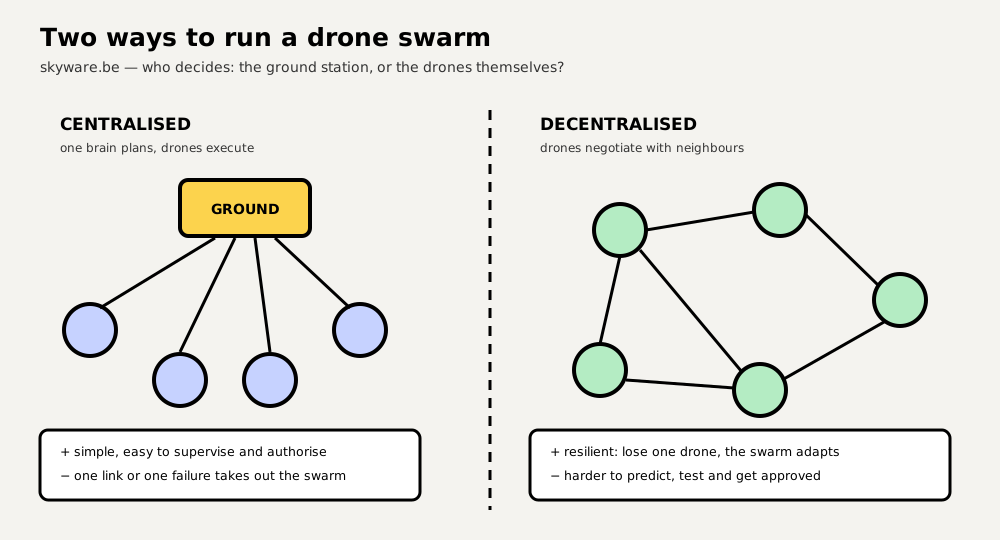
- Centralised: a ground station holds the world model, plans, and tells each drone what to do. Simple to build, easy to supervise, and much easier to explain to a regulator — but the ground link and that single planner are a shared point of failure.
- Decentralised: each drone runs its own logic and negotiates with neighbours over a mesh network. Resilient — lose an aircraft or a link and the rest adapt — but emergent behaviour is harder to predict, test and certify.
Most fielded systems are hybrids: a ground station sets mission intent and constraints, while the drones handle local separation and task-sharing themselves. That split keeps humans meaningfully in command while letting the fleet survive a dropped link.
The four things a swarm needs
- Positioning good enough to fly close. Metre-level GNSS isn't sufficient when aircraft are metres apart — swarms lean on RTK or relative positioning between aircraft.
- A network that tolerates loss. Mesh radio links so drones talk to neighbours directly, degrading gracefully rather than collapsing when one node vanishes — the same RF realities as any datalink, multiplied by N.
- Task allocation. Deciding who covers which area or target — auction-style bidding between drones is a common approach, and increasingly reinforcement learning.
- Onboard autonomy. Each aircraft needs enough onboard intelligence and navigation capability to act without waiting for permission.
Where AI has changed things
Swarm coordination used to be hand-written rules, often bio-inspired (boids-style flocking). The 2026 shift is toward learned coordination: multi-agent reinforcement learning for task allocation and formation, and edge intelligence so decisions happen onboard rather than on the ground. It's genuinely more capable in messy conditions — and genuinely harder to verify, which is the tension running through the whole field: the more adaptive the swarm, the harder it is to prove what it will do.
What swarms are actually used for
- Search and rescue — covering a search area in a fraction of the time, dividing it dynamically as drones find or exclude terrain.
- Large-scale inspection and survey — several aircraft mapping one site or corridor together (see RTK surveying).
- Agriculture — coordinated spraying and monitoring across large fields.
- Defence — the biggest current driver, and the source of most of the funding and technology.
- Entertainment — light shows, the most visible and commercially mature multi-drone operation.
Swarming works well today in controlled, well-understood settings — a known area, a defined task, reliable positioning. The open problems are the interesting ones: coordinating in cluttered environments without perfect positioning, staying coherent when the mesh degrades or is jammed, cybersecurity across many nodes, and — the real bottleneck for civil use — demonstrating to a regulator that a fleet is safe when one pilot supervises many aircraft with emergent behaviour. Expect capability to keep outrunning approval.
If you want to experiment
You don't need ten aircraft to start. Two or three small drones, a PX4/ArduPilot stack, ROS 2 on companion computers, and a simulator will teach you most of the hard parts — clock sync, position sharing, task allocation, and what happens when one node goes silent. Simulate first, fly two, then scale: swarm bugs multiply with aircraft count, and so does the cost of finding them in the air.
Frequently asked questions
What is a drone swarm?
A group of drones that operate as one coordinated system rather than as individually piloted aircraft — sharing information, dividing tasks between themselves and adapting together when conditions change. The distinguishing feature is coordination: a light show of pre-programmed drones is a fleet, while a swarm reacts collectively.
How do drones in a swarm avoid colliding?
Through a mix of planning and reaction: a planner assigns each drone a separated trajectory before flight, drones broadcast their positions to neighbours over a mesh link, and each aircraft runs local avoidance rules that override the plan if something gets too close. Precise positioning (often RTK) makes the separation margins workable.
Are drone swarms legal in Europe?
Multi-drone operations are possible but not routine. Flying several drones with one pilot goes beyond standard Open-category assumptions, so it typically needs a Specific-category operational authorisation with a risk assessment covering the failure modes of the whole fleet. Light shows operate under exactly this kind of tailored approval.